AI-InnoScEnCE
Proiect Horizon Europe — Activ 2025–2027

Știință aplicată
Inovație circulară
Viitor sustenabil

Un consorțiu european de șapte instituții de cercetare și inovare care integrează metodele de Inteligență Artificială în nucleul tranziției spre economia circulară — de la laborator la piață, de la universitate la societate.

7.2 %
Partner Institutions
-30 %
AI Resource Efficiency
7.2 %
Current Global Circularity (Circle Economy, 2024)
🏭 TUHH launches CampusLab Circular Economy — the link between research and future production 🔬 Nature Reviews Materials (2026): ~10,000 articles on AI in materials science compared to 264 in 2014 🌍 Global circularity has decreased by 21% over the past 5 years — AI is the solution (Circle Economy, 2024)

De ce economia circulară are nevoie de Inteligență Artificială acum Why the circular economy needs Artificial Intelligence now Почему циркулярная экономика нуждается в Искусственном Интеллекте сейчас

Conform Raportului privind Decalajul de Circularitate 2024 (Circle Economy), circularitatea globală se situează la doar 7,2% — cu 21% mai puțin față de acum cinci ani. Creșterea populației, intensificarea consumului și presiunile climatice impun o schimbare radicală a modului în care producem, folosim și recuperăm materialele. Economia circulară oferă cadrul conceptual, iar Inteligența Artificială furnizează puterea computațională necesară pentru a-l face funcțional la scară.

According to the Circularity Gap Report 2024 (Circle Economy), global circularity stands at just 7.2% — 21% lower than five years ago. Population growth, intensified consumption and climate pressures require a radical change in how we produce, use and recover materials. The circular economy provides the conceptual framework, while Artificial Intelligence supplies the computational power needed to make it work at scale.

Согласно Отчёту о разрыве цикличности 2024 (Circle Economy), глобальная цикличность составляет всего 7,2% — на 21% ниже, чем пять лет назад. Рост населения, интенсификация потребления и климатическое давление требуют радикального изменения того, как мы производим, используем и восстанавливаем материалы. Циркулярная экономика даёт концептуальную основу, а ИИ — вычислительную мощь для её реализации в масштабе.

AI-InnoScEnCE intervine exact la această intersecție critică: conectând metode de machine learning, NLP și computer vision cu provocările concrete ale ingineriei circulare — de la sortarea automată a deșeurilor la simularea moleculară a noilor materiale biodegradabile, de la cartografierea ecosistemelor de inovare la generarea de oportunități reale de antreprenoriat.

AI-InnoScEnCE intervenes at precisely this critical intersection: connecting machine learning, NLP and computer vision methods with the concrete challenges of circular engineering — from automated waste sorting to molecular simulation of new biodegradable materials, from innovation ecosystem mapping to generating real entrepreneurship opportunities.

AI-InnoScEnCE вмешивается именно на этом критическом перекрёстке: соединяя методы машинного обучения, NLP и компьютерного зрения с конкретными задачами циркулярной инженерии — от автоматической сортировки отходов до молекулярного моделирования новых биоразлагаемых материалов.
"Tranziția spre o economie circulară nu este o opțiune — este singura cale spre reziliența economică și climatică pe termen lung. Inteligența Artificială transformă această tranziție dintr-un deziderat în realitate măsurabilă."
"The transition to a circular economy is not an option — it is the only path to long-term economic and climate resilience. Artificial Intelligence transforms this transition from an aspiration into measurable reality."
"Переход к циркулярной экономике — не вариант, а единственный путь к долгосрочной экономической и климатической устойчивости. Искусственный Интеллект превращает этот переход из стремления в измеримую реальность."
— AI-InnoScEnCE Research Consortium, 2025
821 AI×CE papers in Scopus (2011–2023)
9R Waste hierarchy strategies covered
SDG UN Goals directly supported
📐

AI as General Methodology

Systematic integration of ML tools into research workflows of university engineering and natural science departments

🗺️

AI as Mapping Instrument

Identifying and connecting actors in the academic and industrial ecosystem through NLP models and knowledge network analysis

🎓 🧑‍

AI in University Curricula

Design and implementation of AI training modules for students, researchers and non-academic professionals

💡

AI for Green Entrepreneurship

Creating conditions for the emergence of startups oriented toward scalable circular solutions through AI-led Open Innovation workshops

Șase mecanisme prin care AI redefineşte circularitatea

Research Time Compression

ML models identify relevant patterns in large volumes of data that would require years of human analysis, reducing the research–validation cycle from decades to months. In materials science, the number of publications mentioning AI increased from 264 in 2014 to approximately 10,000 in 2024 (Nature Reviews Materials, 2026).

Deep Learning · Data Mining
🔄

Efficient Resource Recovery

AI-based automated sorting systems and predictive flow models are transforming industrial and municipal waste management. The Wiley review (2025) of literature from 2015–2025 documents significant reductions in landfilled waste and increased material recovery rates through the implementation of computer vision (CV) and machine learning (ML).

Computer Vision · Predictive ML
🧬

Molecular Simulation for New Materials

AI extends the material lifecycle, designs biodegradable bio-based inputs, and transforms end-of-life materials back into high-purity feedstock through AI-guided sensing and control (Nature Reviews Materials, 2026). Self-driving robotic laboratories further compress the digital-to-physical iteration cycle.

Generative AI · Molecular Sim.
🏭

Intelligent Circular Production

IoT, digital twins, blockchain, and AI are among the most frequently cited enablers of sustainability in green supply chains, according to an analysis of 1,962 documents from Scopus and Web of Science (Discover Sustainability, 2025). The main barriers remain cost, integration complexity, and a lack of digital skills.

Industry 4.0 · Digital Twins
🗺️

NLP Ecosystem Mapping

Natural language processing models analyze publications, patents, and market reports to identify hidden collaboration opportunities, knowledge gaps, and potential synergies among academic, industrial, and policy actors within the circular economy ecosystem.

NLP · Graph Analysis
🚀

Circular Business Model Generation

An analysis of 32 peer-reviewed studies (2015–2025) shows that AI is reshaping circular business models through advanced data-driven insights, enabling reuse, repair, and recycling strategies that would not be identifiable through conventional management approaches (Springer ICRES, 2025).

ML · Open Innovation

Ce confirmă știința internațională

♻️

Automated Sorting with Computer Vision

Computer vision systems trained on classified waste datasets achieve higher sorting accuracy than humans, reducing contamination in recycling streams and increasing the economic value of recovered materials. The Wiley review (2025) covering 2015–2025 documents their impact across the entire waste management chain.

🧱

Sustainable Polymers from Organic Waste

The startup EveryCarbon, a spin-off from TUHH Hamburg, received €2.5 million from SPRIND (2025) for the bio-based production of high-performance polymers from organic waste streams — demonstrating that waste can become the starting point for new materials through AI-supported microbial processes.

📈

+25% Efficiency, −30% Production Waste

The first mixed-methods assessment of AI’s impact on industrial production ecosystems (ResearchGate, 2025), based on a bibliometric analysis of 196 peer-reviewed articles (2023–2024), shows that AI can increase resource efficiency indicators by up to 25% and reduce production waste by up to 30% in empirically validated cases.

🌱

Circularity and Climate Change

Annual Review of Environment and Resources (2025) synthesizes national and global evidence on the mitigation potential of the circular economy. The key conclusion: the circular transition has significant decarbonization potential, but the scale of its impact critically depends on its integration into national climate policies and technological support — including AI.

📚 Literatură Ştiinţifică de Referinţă

Baza completă →
ResearchGate · Mixed-Methods 2025

AI as a Catalyst for the Circular Economy: A Mixed-Methods Analysis of Sustainable Production Ecosystems (2023–2024)

A bibliometric analysis of 196 peer-reviewed articles shows +25% resource efficiency and −30% production waste in documented cases. Key barriers: SMEs and emerging economies.

ResearchGate, 2025 DOI →
Nature Reviews Materials 2026

Artificial Intelligence as a Driver of Sustainable Materials and Circularity

Approximately 10,000 materials science articles mentioned AI in 2024 compared to 264 in 2014. AI extends material lifecycles and transforms end-of-life (EOL) waste into high-purity feedstock.

Nature, 2026 DOI →
Wiley · Env. Progress 2025–26

AI-Driven Circular Economy Optimization in Waste Management: A Review of Current Evidence

Narrative review 2015–2025 (Web of Science, Scopus, IEEE, ScienceDirect, Google Scholar). AI is transforming sorting, prediction, and resource recovery in waste management.

Olawade et al. · Wiley, 2026 DOI →
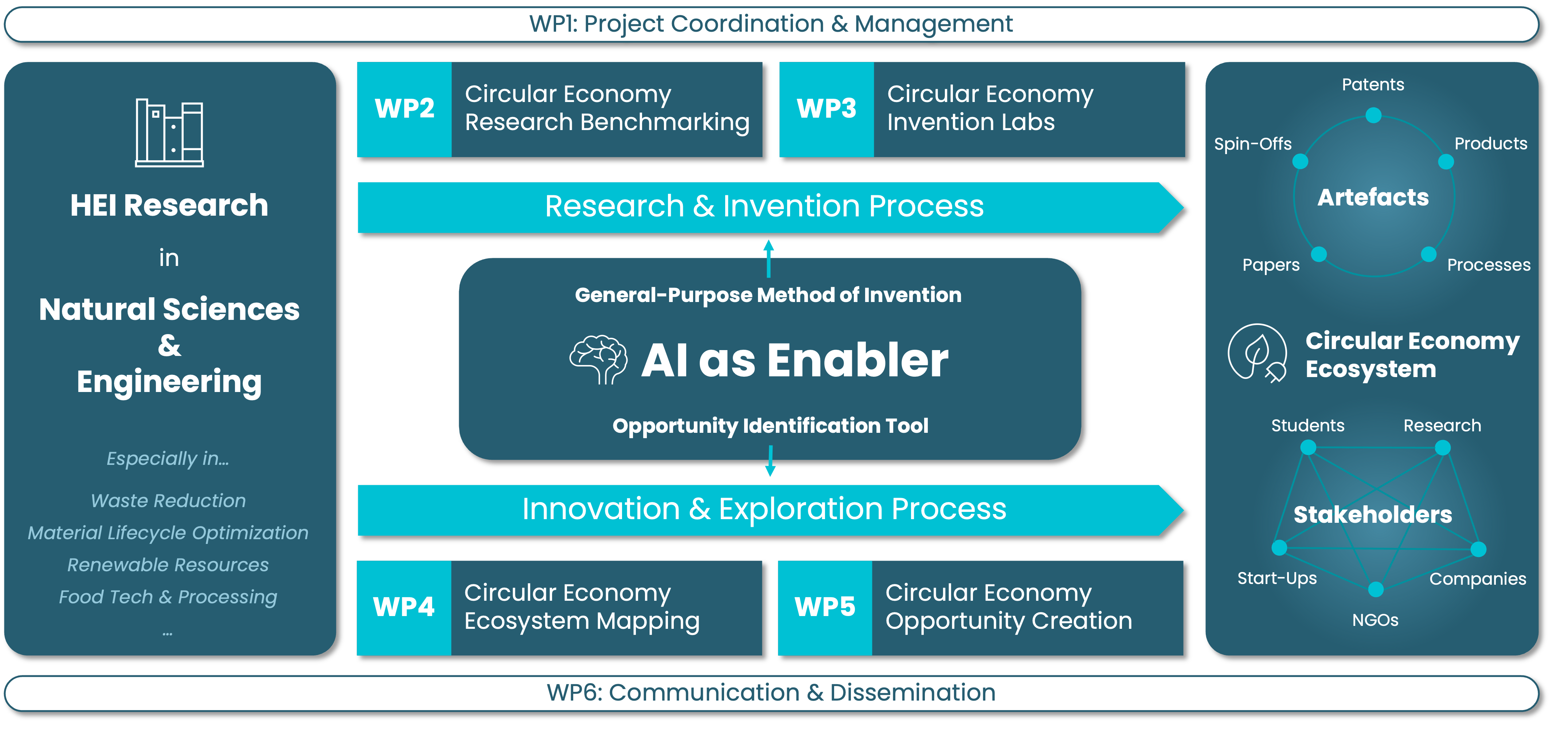
AI-InnoScEnCE Architecture

Cum se articulează proiectul în patru straturi interconectate

Arhitectura proiectului răspunde la trei nevoi simultane...

I
Knowledge Layer

Aggregation and validation of best AI practices in circular research through data-driven benchmarking (WP2).

II
Experimentation Layer

Physical and virtual laboratories for testing AI solutions in real industrial research environments (WP3).

III
Connection Layer

AI-NLP tools that map relationships between stakeholders and identify unexplored synergies at regional and European levels (WP4).

IV
Exploitation Layer

AI-driven open innovation workshops that transform research outputs into concrete entrepreneurial opportunities and viable startups (WP5).

Cei șase piloni operaționali ai proiectului

WP1

Governance & Quality

  • Continuous monitoring of progress against performance indicators
  • Ensuring ethical compliance in the collection and use of research data
  • Financial coordination and reporting to Horizon funding bodies
  • Inclusion and gender diversity policies across all consortium activities
Mai multe →
WP2

White Paper on Circular AI Practices

  • Systematic scanning of Scopus, Web of Science, and IEEE databases for validated AI practices
  • Development and curation of an interactive best-practice platform accessible to researchers
  • Inter-institutional validation workshops to calibrate platform recommendations
  • Building an active community for practice exchange among partner universities
Mai multe →
WP3

Living Innovation Laboratories

  • Intensive hands-on training modules in ML, CV, and NLP applied to real circular economy challenges
  • Setup of physical labs in partner campuses and shared virtual sandbox environments
  • Pilot research projects with local industry in waste, materials, and energy domains
  • Public Demo Day sessions presenting experimental results
Mai multe →
WP4

Regional Ecosystem Mapping

  • Identification and quantitative profiling of all relevant actors in the regional circular ecosystem
  • Development of an AI-NLP tool for analysis and visualization of inter-institutional relationships
  • Stakeholder engagement sessions to validate AI-generated ecosystem maps
  • Comparative regional reports on the maturity of circular innovation ecosystems
Mai multe →
WP5

Opportunity Factory

  • Open innovation scenarios adapted to the industrial and academic contexts of each partner
  • Creative pipelines for identifying commercial opportunities for validated circular AI solutions
  • Conversational AI assistant for real-time facilitation of open innovation workshops
  • Execution and systematic evaluation of open innovation sessions with mixed academic–industry teams
Mai multe →
WP6

Amplification & Legacy

  • Building a multilingual and multichannel digital communication infrastructure for the project
  • Active dissemination strategy within the academic, industrial communities and the general public
  • Planning the sustainability of results after the end of Horizon funding
  • Blog, podcast, and thematic newsletter with updates from the field and the project
Mai multe →

Frontiera cunoașterii în AI & Economie Circulară

Industry 4.0 Technologies in Green Supply Chain Management: Bibliometric & Structured Text Analysis 🌿 Springer · Discover Sustainability · 2025

Industry 4.0 Technologies in Green Supply Chain Management: Bibliometric & Structured Text Analysis

Analysis of 1,962 Scopus/WoS documents: IoT, digital twins, AI, blockchain are key catalysts. Common barriers: cost, integration complexity, digital skills gap.

Wiley · J. Industrial Ecology · 2025

Is Circular Economy a Failing Sustainability Paradigm? Not Necessarily

Global circularity: 7.2%, 21% lower than 5 years ago. Incremental approach (recycling → reuse → prevention) is more feasible than radical systemic transformation for SMEs.

Annual Review of Env. & Resources · 2025

The Circular Economy and Climate Change: The State of Evidence on Mitigation Potential

Synthesis of global evidence: significant mitigation potential, but impact scale depends on integration into climate policies and technological support.

Nature Reviews Materials · 2026

AI as a Driver of Sustainable Materials and Circularity

From 264 AI-mentioning materials papers in 2014 to ~10,000 in 2024. Self-driving robotic labs compress the digital→physical cycle. Mandatory pairing: AI + innovative business models + collection infrastructure.

🌿 Landmark Study

AI-Driven Circular Economy Optimization in Waste Management: A Review of Current Evidence (Wiley, 2025–26)

Comprehensive narrative review of peer-reviewed literature published between 2015 and 2025, covering Web of Science, Scopus, IEEE Xplore, ScienceDirect and Google Scholar. Critical evaluation of AI approaches potential and limitations across the entire waste management lifecycle confirms that AI technologies — intelligent sorting systems, predictive models, complex decision automation — radically transform resource recovery and environmental impact reduction. Technical, economic and systemic barriers remain significant for large-scale adoption.

Instrumente digitale construite de consorțiu

WP2 WP2 · Cercetare
Instrument de Cercetare Acces Liber

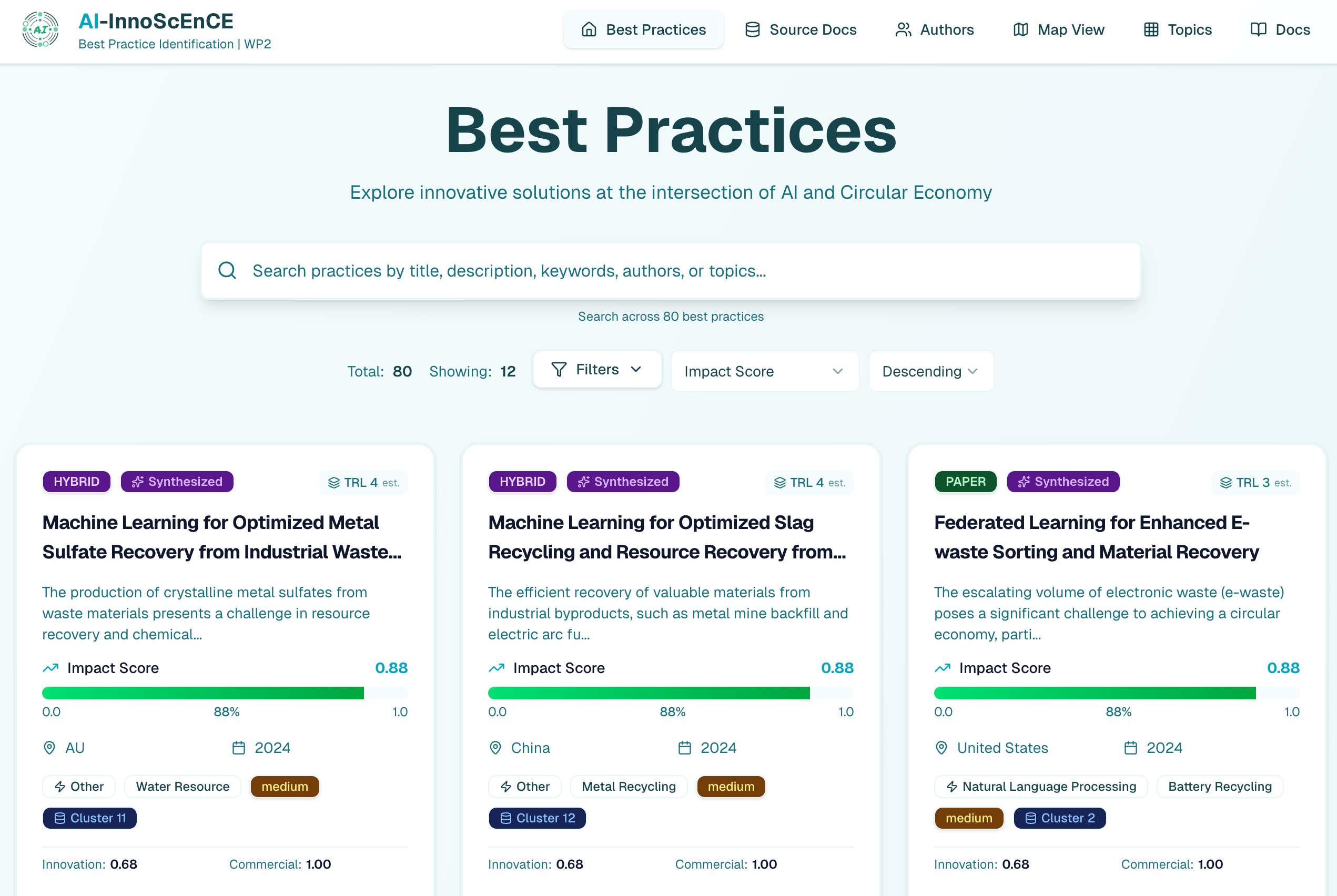
Biblioteca Vie a Bunelor Practici AI în Economia Circulară

Un depozit interactiv și actualizat în timp real...

Accesează Platforma →
WP4 WP4 Nou
NLP · Rețele Pentru Stakeholderi

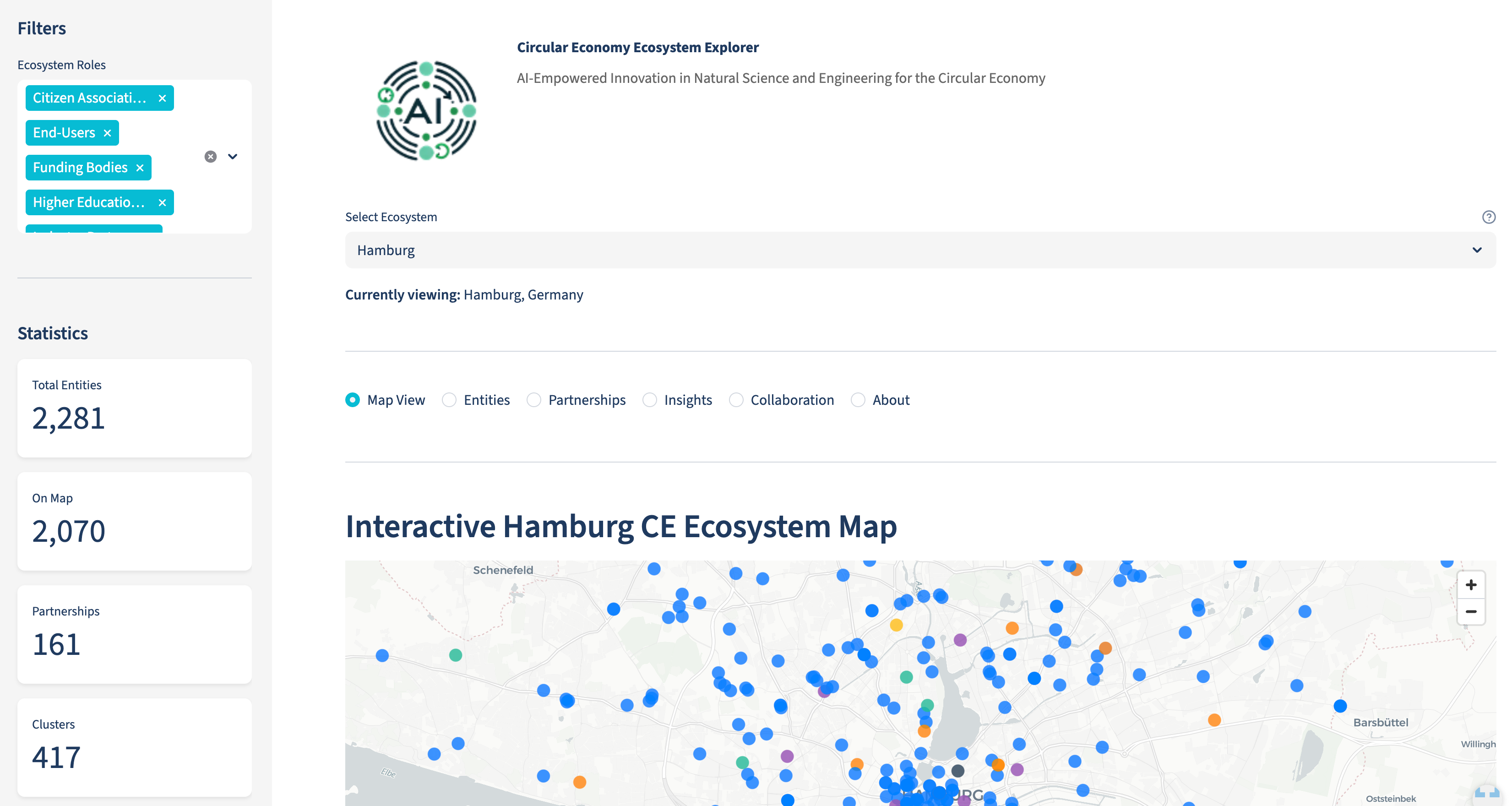
Radarul Ecosistemului de Inovare Circulară

Un instrument bazat pe procesarea limbajului natural...

Accesează Platforma →

Patru frontiere tehnico-științifice vizate

🗑️

Waste Flow Minimization

Prediction and redirection algorithms for industrial and municipal waste before it is generated.

🔬

Extended Material Lifecycles

Molecular simulation using ML to design materials with extended lifecycles and easy reintegration.

Production on Renewable Resources

AI models for real-time balancing of renewable energy demand and supply for partner industries.

🍃

Bioeconomy & Food Technology

Reducing food waste and valorizing agricultural by-products through intelligent prediction and allocation systems.

Actorii conectați prin ecosistemul AI-InnoScEnCE
🎓 Students & Master’s Students 🔭 PhD Candidates & Researchers 🚀 Startups & Spin-offs 🏗️ SMEs & Industry 🌱 NGOs & Civil Society Policy Makers · EU Institutions Technology Transfer Offices

Ce va schimba AI-InnoScEnCE în practică

📄

Indexed Academic Corpus

Research articles published in Web of Science and Scopus indexed journals that document validated AI methodologies in real circular economy contexts, forming a reference corpus usable by the global research community.

10+ articles / papers
🔒

Intellectual Property Portfolio

Patents, copyrights, and other forms of intellectual property protection resulting from technical innovations generated in the project laboratories, contributing to strengthening the innovation capacity of partner institutions.

Protected IP
🚀

Newly Established Companies

Startups and spin-offs that commercialize AI solutions for concrete circular economy challenges — from automated waste sorting systems to matching platforms for industrial resource-sharing economies.

Min. 2 startups
📊

Open Data & Methodologies

Datasets, trained models, and research methodologies published in open-access format, enabling the global community to build upon project results and accelerate AI adoption in circular research.

Active Post-Project Network
🌐

Active Post-Project Network

An academic–industry collaboration cluster that survives Horizon funding, with at least 3–4 newly signed partnership agreements between institutions that previously did not collaborate, creating a multiplier effect of European investment.

3–4 new partnerships

Șapte instituții, o misiune comună

Germania, Serbia și Republica Moldova — trei contexte...

🇩🇪 Hamburg, Germania

Hamburg University of Technology (TUHH)

A technical university founded under the motto “Engineering to Face Climate Change,” TUHH leads the consortium through the CampusLab Circular Economy — an infrastructure that connects fundamental research with future production. The spin-off EveryCarbon, funded with €2.5 million in 2025, illustrates how TUHH transforms organic waste into high-performance bio-based polymers through AI-supported microbial processes.

tuhh.de →
🇷🇸 Novi Sad, Serbia

Novi Sad, Serbia

The largest university hub in Serbia, with over 16,500 students, 1,000+ staff members, 13 departments, 90+ study programs, and 33 scientific centers. In 2024, it co-organized the Eastern European Machine Learning Summer School with 190 participants from 47 countries.

ftn.uns.ac.rs →
🇲🇩 Cahul, Moldova

Technical University of Moldova "Bogdan Petriceicu Hasdeu" University Center (USC)

The academic anchor of the consortium in the Republic of Moldova, USC brings expertise in regional economic systems analysis and applied engineering. Its participation establishes the first AI research infrastructure dedicated to circular economy challenges in southern Moldova.

usch.md →
🇩🇪 Hamburg, Germania

TUTECH Innovation GmbH

The private interface between academic research and commercial valorisation, TUTECH has been operating at the boundary between the university laboratory and the free market since 1992. Specialised in IP protection, spin-off support and connecting research results with SMEs in the circular economy ecosystem, TUTECH ensures the long-term economic viability of project-generated innovations.

tutech.de →
🇷🇸 Novi Sad, Serbia

Institute for AI Research and Development of Serbia (IVI)

The institute won the "Most Innovative AI Research Idea" award at DSC Europe 2024 for the "AI in Mammography" project and coordinates Serbia's AI Development Strategy 2025–2030. Co-organised the Eastern European Machine Learning Summer School 2024 — an event bringing 190 talents from 47 countries to Novi Sad. Research groups cover HCI, AI in healthcare, Computer Vision, Green AI and Smart Factory.

ivi.ac.rs →
🇲🇩 Cahul, Moldova

INOTEK EU Innovation Centre Cahul

An innovation centre co-funded by the European Union and the Swedish Government, with the mission of generating qualified IT jobs and retaining young talent in southern Moldova. INOTEK holds the regional gender inclusion record in STEM: more than 60% of programme participants are women and girls. Within AI-InnoScEnCE, it equips and operates the physical AI experimentation laboratories in Cahul.

inotek.md →
🇲🇩 Cahul, Moldova

Incubatorul de Afaceri Cahul (IACH)

The entrepreneurial engine of the project in Moldova, IACH operates in a dedicated 1,494 m² building housing both office and production spaces. Its track record is concrete: 22 active resident companies, 80 jobs created — of which 37 for young people and 19 for women — and 18 startups launched since founding. In AI-InnoScEnCE, IACH coordinates the incubation pathway for startups generated through Open Innovation workshops, ensuring the transition from prototype to functioning company.

iach.md →

Alătură-te tranziției spre economia circulară inteligentă

Studenți, cercetători, antreprenori și industrie — fiecare actor contează în ecosistemul AI-InnoScEnCE.

Scrieți-ne. Suntem gata să colaborăm.

Consorțiul AI-InnoScEnCE răspunde solicitărilor de colaborare, parteneriate academice sau industriale, cereri de informații despre participarea la proiect și propuneri de co-cercetare în termen de maximum 5 zile lucrătoare.